
How to Swap Cardboard Filament Rolls onto a Bambu Lab Spool Without Respooling
Tags: bambu lab, cardboard spools ams, filament spools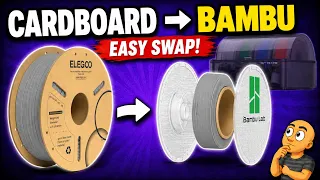
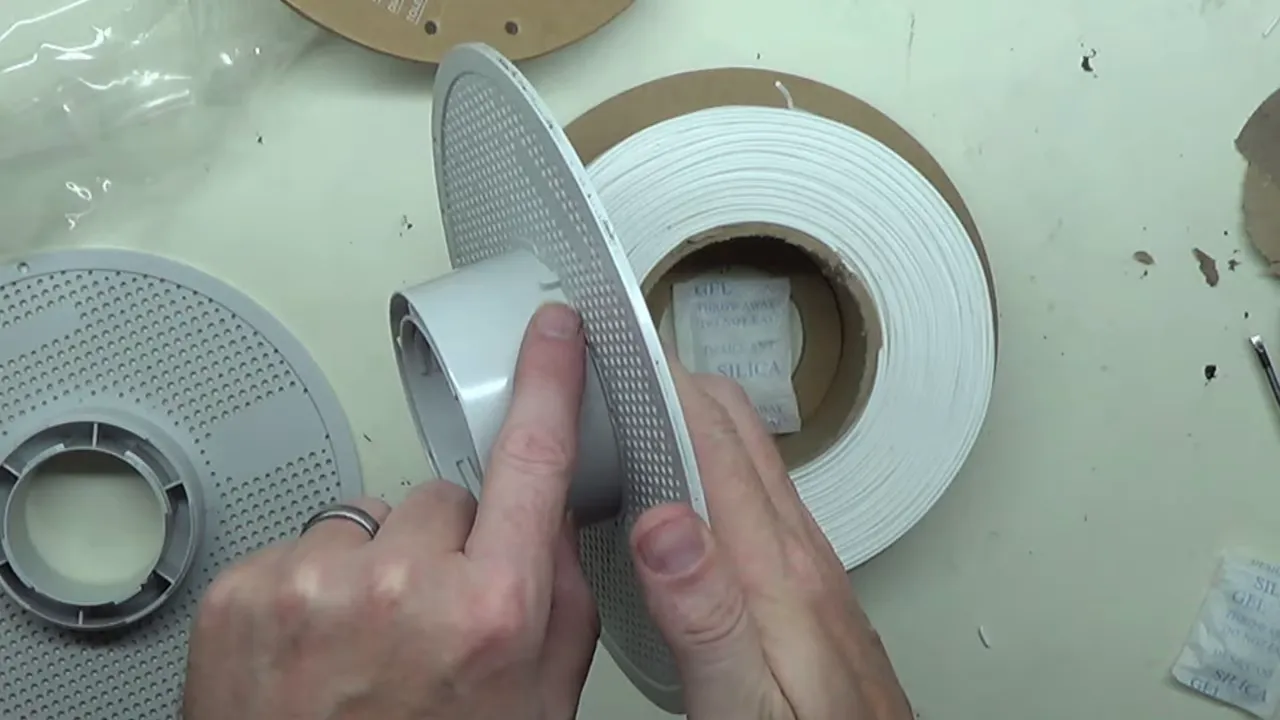
Give it a small wiggle as you press. You should feel it settle flush once the tab has entered the recess. Apply firm, controlled pressure while keeping everything aligned.
With that first plastic half seated, turn the roll over so it supports the filament from underneath.
6. Remove the second cardboard side
Release the filament end from the remaining cardboard side before removing it.
Use exactly the same bend-and-return method: bend a section upwards, push it back down, rotate the roll, and repeat. Peel away the large cardboard flange once it has loosened.
Then tear and lift away the remaining cardboard around the inner edge, using your fingers against the inside of the core as before. The fitted plastic half now supports the winding while you work.
7. Fit and lock the second spool half
Place the other Bambu Lab spool half onto the exposed side. Apply gentle downward pressure while turning it until you feel the centre parts align and drop into place.
Hold the bottom half still and twist the top half to lock it. You will feel resistance, followed by the locking click.
Do not stop at the point where the second half merely drops into place. It still needs the final twist to lock the two halves together.
Finally, feed the loose outer filament end through a retaining hole in the plastic spool so it cannot unwind. The transfer is complete and the spool is ready for your AMS.
Transfer an Opened or Partly Used Cardboard Roll
A partly used roll follows the same basic process. The main difference is that you may no longer know which side has the original notch, and there may be some loose filament to tidy up first.
1. Wind back the loose filament and secure it
Wind the loose length back onto the cardboard roll as neatly as you can. It does not have to look perfect, but keep it taut.
Push the end through one of the cardboard retaining holes and pull it snug. That gives you a controlled roll to work with rather than a loose length that can unravel as you remove the sides.
2. Remove the first side and make a notch if needed
You may be able to feel where the short inner filament tail protrudes through the cardboard, but often you cannot. Choosing the side with the original recess can therefore be a bit of a guess.
Remove the first cardboard flange and its remaining inner-edge material using the same technique as for a fresh roll.
If there is no suitable recess on that side, it is not the end of the world. Make a small one yourself:
- Place the tip of a flat-blade screwdriver against the edge of the cardboard core opening.
- Push it into the cardboard carefully.
- Wiggle it to form a recess for the plastic spool’s locating tab.
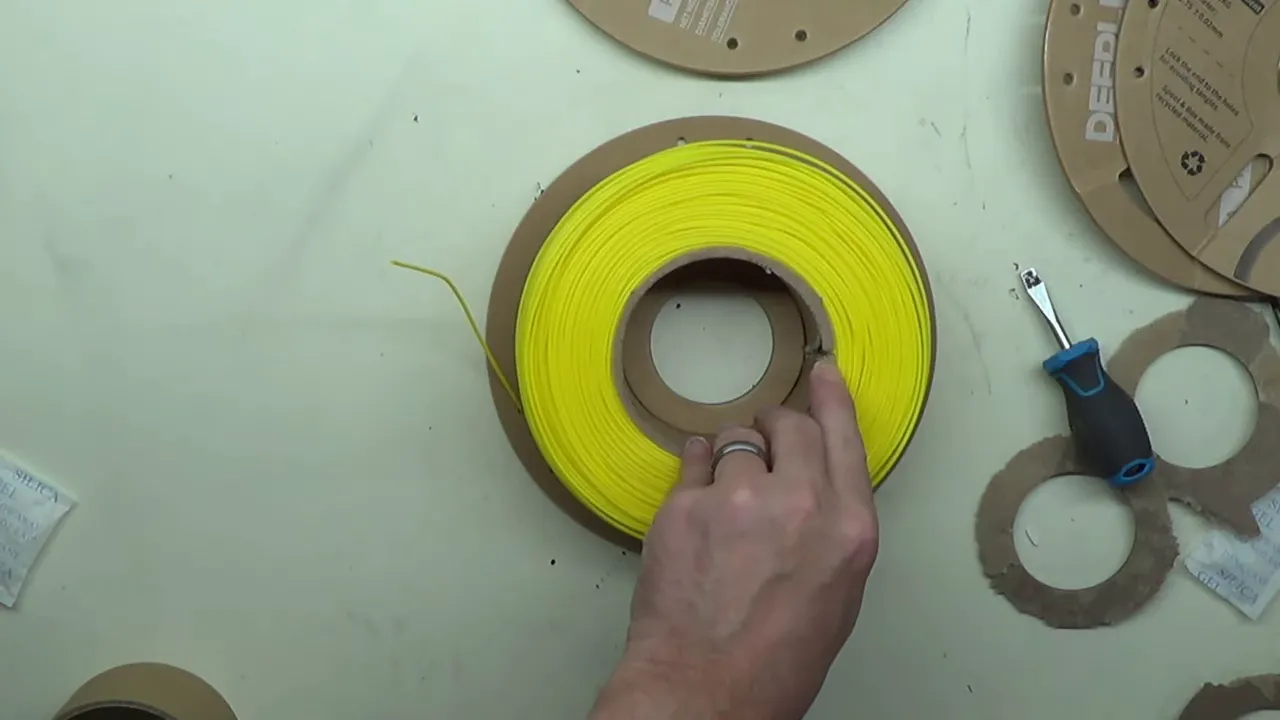
Line up the tabbed spool half with your new recess. Press it into place, giving it a gentle turn or wiggle to check that it has entered correctly, then seat it firmly.
3. Turn the roll over and finish the transfer
Flip the reel over with the fitted plastic half underneath. Release the outer filament end from the remaining cardboard retaining hole, keeping hold of the loose length.
Remove the second cardboard flange and the leftover cardboard around the core opening. If the short inner filament tail is still caught in the cardboard, pull it free and trim the protruding excess as needed. This is the small tail at the core, not the outer end you will feed into the AMS.
Fit the remaining plastic spool half, turn it gently until it drops into position, then hold the bottom half and twist the top half until it locks.
Take up the slack in the outer filament, wind back any loose length, and secure the end in a retaining hole. The main winding should still be intact, apart from the short length you handled during the swap.
Check the Spool Before Putting It in the AMS
- Both halves are seated: the tabbed half is flush, and the other half has dropped into its mating position.
- The lock is engaged: you have completed the final twist and felt or heard the click.
- The inner tail is free: it is not still caught in the cardboard.
- The outer end is secured: it is held in a retaining hole rather than left loose.
That is all there is to it. With a compatible roll and a spare reusable spool, you can keep the filament wound as it is, replace the cardboard sides with plastic ones, and avoid using cardboard spool adapter rings. The same approach works whether the roll is fresh or already partly used.
Made with VideoToBlog using How to swap Cardboard filament rolls over to Bambu Lab spool