
OWON SDS1022 Review: Is This Compact Oscilloscope Worth It?
Tags: 20MHz oscilloscope, budget oscilloscope, CRT oscilloscope, digital oscilloscope, digital storage oscilloscope, electronics repair, electronics test equipment, electronics workshop, oscilloscope for beginners, oscilloscope review, OWON oscilloscope, OWON SDS1022, OWON SDS1022 review, Sortitoutman, workshop tools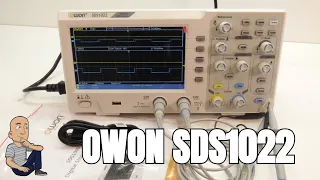
Sometimes upgrading your workshop equipment isn’t about getting the biggest, most powerful or most expensive replacement. Sometimes it’s simply about finding something that does what you need while taking up considerably less space.
That’s exactly why I decided to purchase the OWON SDS1022 digital storage oscilloscope.
My previous oscilloscope was a conventional CRT-based instrument, somewhere between 25 and 30 years old at the time. Despite its age, there was absolutely nothing wrong with it. In fact, it was still perfectly capable of doing the job.
The problem was its size.
It was roughly the size of a microwave oven, and having recently reorganised my workshop to create more usable space, I wanted something that wouldn’t occupy such a large portion of my workbench.
The OWON SDS1022 caught my attention because it offered a compact, lightweight alternative with the basic functionality I needed.
So, was switching from a traditional CRT oscilloscope to this small digital model a worthwhile move?
Let’s take a closer look.
What Is the OWON SDS1022?
The OWON SDS1022 is a compact, two-channel digital storage oscilloscope designed for general electronics testing, fault-finding and educational use.
Unlike older analogue CRT oscilloscopes, which use a bulky cathode-ray tube to display waveforms, the SDS1022 uses a flat colour LCD display.
That makes it considerably slimmer than the older equipment many electronics enthusiasts will remember using.
It isn’t intended to compete with high-end laboratory oscilloscopes, but its specifications make it a potential option for hobby electronics, general repairs and basic workshop measurements.
OWON SDS1022 Technical Specifications
According to OWON’s published specifications, the SDS1022 offers:
| Specification | OWON SDS1022 |
|---|---|
| Oscilloscope type | Digital storage oscilloscope |
| Channels | 2 |
| Bandwidth | 20MHz |
| Maximum sample rate | 100MSa/s |
| Display | 7-inch colour TFT LCD |
| Screen resolution | 800 × 480 pixels |
| Record length | 10K points |
| Connectivity | USB host and device interfaces |
| Dimensions | 301 × 152 × 70mm |
| Weight | Approximately 1.1kg |
These are manufacturer specifications rather than independently verified performance measurements from my video.
For the full technical details, visit the OWON SDS1022 product page.
Why I Replaced My Old CRT Oscilloscope
My decision to replace my old oscilloscope was primarily about reclaiming workspace.
I’d recently made changes to the workshop layout, with the aim of creating more usable bench space for electronics repairs, testing and other projects.
Although the old CRT oscilloscope still worked perfectly well, it was a substantial piece of equipment.
Anyone who’s owned one of these older instruments will know how much space they can occupy. They’re deep, relatively heavy and not particularly convenient to move around.
The idea behind purchasing the OWON was simple: find something smaller that I could keep on a shelf and bring into use whenever it was needed.
I was also realistic about the trade-off.
The SDS1022 wasn’t necessarily going to replace every capability of my older oscilloscope. However, for the type of basic testing I generally needed, I expected it to be perfectly adequate.
For me, gaining back the workbench space was a major advantage.
OWON SDS1022 Unboxing: What’s Included?
Opening the box, the first thing that struck me was just how small the OWON SDS1022 looked compared with my old CRT oscilloscope.
The package included the main oscilloscope, documentation and the accessories needed to get started.
Inside the box I found:
- The OWON SDS1022 digital oscilloscope.
- User manual and documentation.
- A software CD.
- Power cable.
- Oscilloscope probes.
- Probe accessories, including interchangeable identification rings.
It’s worth noting that the exact accessories supplied can vary between packages and distributors.
The inclusion of probes was particularly welcome, as it meant I could get the oscilloscope connected and running without having to purchase a separate set immediately.
Build Quality and First Impressions
Considering this is a relatively inexpensive digital oscilloscope, I wasn’t expecting anything particularly impressive when it came to construction.
However, my initial impressions were actually quite positive.
The main unit felt better made than I’d anticipated, and it was surprisingly lightweight compared with the equipment I was used to.
At approximately 1.1kg according to the manufacturer, it’s an enormous difference from a large conventional CRT instrument.
The slim design is probably its most obvious advantage.
Rather than having a large, deep enclosure extending across the workbench, the OWON has a relatively thin body that makes it much easier to accommodate in a smaller working area.
Connections and Controls
Looking around the unit, you’ll find the two oscilloscope channel inputs, the front-panel controls and USB connectivity.
There’s also a small carrying handle, making it easier to move the oscilloscope around the workshop.
Another practical detail is the power arrangement. The unit connects using a conventional power cable rather than requiring a separate external power brick.
It’s a small detail, but when you’re trying to keep a workbench tidy, having fewer external power supplies cluttering the area is always welcome.
Are the Included OWON Probes Any Good?
One thing I wanted to check during the unboxing was the quality of the supplied oscilloscope probes.
Cheap test equipment doesn’t always come with particularly impressive accessories, so it’s something worth looking at.
My first impressions of the included probes were positive.
They appeared reasonably well made, and the package included the usual probe tips and accessories, along with different coloured identification rings.
These coloured rings are useful when you’re working with multiple channels, allowing you to identify which probe belongs to which input.
I wouldn’t claim that the probes have been independently tested against high-end alternatives in this video, but from an initial inspection they looked perfectly reasonable.
Powering Up the OWON SDS1022 for the First Time
With the initial inspection complete, it was time to switch the oscilloscope on and see what the display looked like.
Coming from a conventional CRT instrument, one of the biggest changes is obviously the move to a flat colour screen.
The SDS1022 uses a 7-inch display, which is relatively generous considering the overall size of the instrument.
On powering up the unit, my first impression was that the display looked good.
The waveforms and controls were clearly presented, and it felt like a practical solution for the kind of occasional workshop measurements I wanted to make.
Checking and Adjusting the Probes
After powering up, I connected the supplied probes and carried out a basic probe compensation check.
This is an important initial step when setting up an oscilloscope, as an incorrectly compensated probe can distort the displayed waveform.
Using the oscilloscope’s reference square-wave signal, you can adjust the probe compensation until the waveform has the correct shape.
An under-compensated or over-compensated probe may display rounded corners or excessive overshoot rather than a properly formed square wave.
In the video, I make the necessary adjustments to obtain a suitable square-wave display before repeating the process for the second channel.
Both channels were then ready for use.
This was a basic setup and first-impressions exercise, rather than a detailed test of bandwidth, measurement accuracy or the instrument’s complete feature set.
OWON SDS1022 vs an Older CRT Oscilloscope
The main question for me was whether a small digital oscilloscope could comfortably take the place of my much larger conventional instrument.
There are certainly advantages and disadvantages to both approaches.
Advantages of the OWON SDS1022
- Much smaller: Its slim design occupies considerably less workshop space.
- Lightweight: Easier to move around or store when not in use.
- Modern LCD display: A clear colour screen instead of a conventional CRT.
- Two input channels: Useful for general dual-channel waveform measurements.
- Digital functionality: Waveform storage and measurement features that aren’t necessarily available on older analogue instruments.
- Practical power arrangement: No separate external power brick to accommodate.
Where the Older Oscilloscope May Still Have Advantages
It’s worth remembering that a newer digital oscilloscope isn’t automatically better in every respect.
My older CRT instrument was a substantial piece of test equipment, and despite its age it still worked properly.
The OWON SDS1022 is an entry-level digital model, so its 20MHz bandwidth and 100MSa/s sample rate are important limitations to consider when deciding whether it suits your work.
For anyone regularly working with faster signals, complex digital electronics or applications that demand greater measurement performance, a higher-specification oscilloscope may be more appropriate.
And depending on the capabilities of your existing equipment, switching to an inexpensive digital model could involve compromises.
For my requirements, however, the attraction was that the OWON provided the basic functionality I needed without monopolising my workbench.
Who Is the OWON SDS1022 Suitable For?
Based on its published specifications and my initial experience, the SDS1022 is worth considering for users who need a straightforward, compact digital oscilloscope.
Potential applications include:
- General hobby electronics.
- Basic electronics fault-finding.
- Low-frequency signal measurements.
- Educational electronics projects.
- Occasional workshop testing.
- Replacing a large, ageing oscilloscope where space is limited.
However, it’s important to consider the bandwidth and sampling specifications before buying any oscilloscope.
If your work involves high-frequency signals or demanding measurements, you may find that the SDS1022 doesn’t provide sufficient performance.
Likewise, if you already own a perfectly good oscilloscope and have plenty of room for it, replacing it purely because it’s old may not make much sense.
My circumstances were different because saving space was one of my main priorities.
Is the OWON SDS1022 Worth Buying?
That really depends on what you want from an oscilloscope.
If you’re looking for the highest possible bandwidth, advanced triggering or professional laboratory-grade performance, this probably isn’t the instrument you’d choose.
But if you’re working on straightforward electronics projects and want a compact, basic digital oscilloscope, the SDS1022 has a number of appealing characteristics.
It’s small, relatively lightweight, has a useful colour display and provides two measurement channels.
For me, the biggest selling point was simply getting rid of the enormous CRT oscilloscope taking up valuable space in my workshop.
And based on the initial unboxing and setup, the OWON made a positive first impression.
Of course, these are my impressions from when I first purchased and demonstrated the instrument in 2019, rather than a long-term reliability assessment or comparison against more recent oscilloscope models.
OWON SDS1022: Frequently Asked Questions
Is the OWON SDS1022 a two-channel oscilloscope?
Yes. The SDS1022 features two analogue input channels, allowing two signals to be observed and compared.
What is the bandwidth of the OWON SDS1022?
The SDS1022 has a manufacturer-specified bandwidth of 20MHz and a maximum real-time sample rate of 100MSa/s.
Does the OWON SDS1022 come with probes?
My unit was supplied with a set of probes and accessories. Package contents may vary, so it’s worth checking exactly what’s included when purchasing.
Can it replace an old analogue CRT oscilloscope?
For some applications, yes. A compact digital oscilloscope can provide the functionality needed for routine testing while occupying much less space. However, you should compare the measurement capabilities of both instruments before replacing an existing oscilloscope.
Final Thoughts
My first experience with the OWON SDS1022 was a positive one.
It was considerably smaller than my old CRT oscilloscope, felt better made than I’d expected and came with a reasonable selection of accessories.
The colour display looked good when powered up, and the initial probe compensation procedure was straightforward.
More importantly, its compact design meant I could reclaim a substantial amount of space in my workshop.
That was the whole point of buying it in the first place.
It’s not necessarily the right oscilloscope for everyone, and I wouldn’t suggest replacing a perfectly good higher-specification instrument simply because this one is newer and smaller.
But if you’re in a similar position to the one I was in, with an ageing CRT oscilloscope occupying far more workbench space than you’d like, a compact digital alternative such as the OWON SDS1022 is certainly worth considering.
For a closer look at the unboxing, build quality, display and initial setup, you can watch my original video at the top of this article.
For more hands-on electronics, workshop equipment and technology reviews, visit Sortitoutman.com and subscribe to Sortitoutman on YouTube.